



Somehow, my career, which stretches back over forty years, feels like a neighbourhood corner store: being in the middle of it all and offering a little bit of everything that people need. Not solving every problem, but contributing things that help improve people's lives and our community.
Over the years, I've worked on:
-
- community building: projects, campaigns, and ideas that have helped communities organize or supported community engagement
- organizing ourselves: founding new organizations and networks to meet ever-changing need
- innovation: projects that have a ripple effect across the movement
- creative marketing: using a movement to raise awareness and help people take action
- strategic planning: strategic analysis that embraces complexity to find elegant solutions.
Here are some of the highlights.
The Blue Ring (Current)
 How can we describe a complex social movement for a better future? The solution: a simple icon.
A blue ring.
The blue ring is a symbol for our climate, and for our climate movement.
Like the 3Rs logo from 1970, it is free to use. No one owns it. Unlike the 3Rs, it is backed by a starter set of values, a vision, and guiding principles that provides common ground and is a buffer against greenwashing.
This is a work in progress, as we take time to build awareness and interest not just in the blue ring, but the strategic marketing ideas that it gives rise to.
Find out more at climatemovement.net or on my Substack page
We Conserve (2004 - 2011)
It's every organization's dream - a major donor who believes in your mission, provides core funding, and helps promote your programs.
In 2004, The Beer Store was looking to consolidate its in-store coin boxes into one box and three charities: one selected by the employees union, one to reduce drinking and driving, and one environmental. They selected the Conservation Council of Ontario because of its province-wide mandate and scope, but also because the conservation message fit well with The Beer Store’s deposit-return system and its commitment to energy conservation.
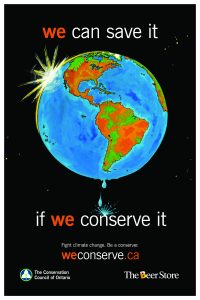
The Beer Store became a major sponsor of the We Conserve campaign, a partner in the Doors Closed campaign. It also ran promotional posters in its 450 retail stores across the Province.
Doors Closed (2005-2010)

In response to the Province’s “Ontario Conserves” campaign, we at the Conservation Council of Ontario (CCO) had launched a mirror campaign, “We Conserve” to promote voluntary leadership. We needed a quick win – a campaign to tackle a hot-button issue and win support for conservation.
We found it in air-conditioned sidewalks. In the heat of the summer, retailers were running air conditioning with wide open front doors to entice customers into their super-cooled stores. The public response was visceral – “Why should I have to conserve energy at home when stores are blasting out air-conditioning onto the sidewalks?!”
The easy approach would have been to organize a boycott, or call for provincial regulation or city by-laws. But we saw the potential for a win-win situation by promoting stores that did the right thing.
We designed a simple poster that could be printed in small batches to include local distribution partners and sponsors, and put out the call for community groups and volunteers to help distribute posters. In particular, we asked for help for a one-week blitz leading up to the second anniversary of the blackout on August 14, 2005.
The response was amazing: over 5,000 posters were distributed by 24 organizations in 15 communities. Here’s the full 2005 final report.
The campaign peaked in 2006 (campaign report) and continued for five years before being retired. It was a tremendous success, in terms of building partnerships, developing a culture of conservation, and in curtailing a wasteful practice. The campaign was adapted in the United Kingdom, and at least one utility, Toronto Hydro, integrated the message into its conservation marketing with a window cling for stores.
Lighten Up (2006)
This one was just plain fun!
 With the advent of compact fluorescent lightbulbs in the early 2000s, we needed a celebrity to spearhead an electricity conservation campaign, and a friend introduced me to Colin Mochrie, Canada’s improv genius and a wonderful, giving person who was able to run with just about every idea we threw at him.
We called our campaign “Lighten Up”. The idea was to make conservation fun, and to get people to start saving energy by turning down the A/C, switching to compact fluorescent lightbulbs, or taking a pledge to use less.
I wrote a number of 30 second radio clips, and we headed into the studio. Here are some samples:
Introducing Colin:
New Year’s Pledge:
Save the Arctic:
Save the Bulbs:
Move to Australia:
Community Action (1993 - ongoing)
Is there a simple, low-cost way to organize and support community-based action?
In the early 1990's, Environment Canada asked the Conservation Council for help in engaging communities on pollution prevention through the national Green Plan. I proposed we first help local groups to organize for action, with a community network and a community action plan.
A community organizer's manual was developed through the Conservation Council of Ontario. Seven Ontario communities took up the challenge. Three of them (Elora, Port Hope, and Thunder Bay) used their community action plans to secure provincial funding under a new Ontario Green Communities program. The City of Toronto community network ran a Toxic Free campaign to promote alternatives to household hazards, and the City of Cambridge still hosts annual community network meetings to this day.
The community manual has since been updated, and additional resources are available on the Climate Action Canada website.
Jane's Walk (2007- Ongoing)

How do we get people interested in urban design and community building? The solution: Jane's Walk, an annual celebration of Jane Jacobs and the work of community leaders around the world.
In 2007, as chair of the Ontario Smart Growth Network, I came up with an idea for a series of community walks to showcase community design and local groups. The idea was picked up by friends of the late Jane Jacobs who made the magic happen, and within months we ran the first Jane's Walk weekend in Toronto on the first weekend of May.
By 2016, there were over 1,000 Jane's Walks in 212 cities and 36 countries across 6 continents.
It is still running running strong today.
Ontario Smart Growth Network (2003-2016)
It's 2002, and urban sprawl is running rampant in Ontario. Several of Ontario's environmental leaders attend a national smart growth conference in Winnipeg, and we return with a recognition that if we need to join forces to tackle the pro-development forces.
 The Ontario Smart Growth Network (OSGN) was formed in 2003, hosted by the Conservation Council of Ontario and with the Federation of Ontario Naturalists, the Sierra Club (Ontario Chapter), the Canadian Institute for Environmental Law and Policy, the Pembina Institute, and the Toronto Environmental Alliance as early provincial members. All told, about 80 groups from across the province sign on, and the campaign to replace urban sprawl with smart growth is on. With Jane Jacobs endorsing our vision for smart growth, and with a groundswell of public concern, we were able to turn the Province around.
The OSGN and its members were instrumental in creating the demand for a new approach to planning and development, and in 2005, the Province introduced the Places to Grow Act, new density requirements for municipalities, and the Ontario Greenbelt to protect prime farmland around Toronto.
With success came the challenge of implementation, and here things fell apart. The Growth Plan included very little funding for community engagement (outside of setting up a Greenbelt Foundation). Even now, at a time when community engagement and support is vital for achieving the goal of a "complete community", there is precious little funding available for community projects or provincial organizations, let alone a provincial network.
The OSGN wound up in 2016.
The Conservation Council of Ontario (1984 - 2011)

When a cause is shared by many, a network can make a world of difference.
A network can be empowered by its membership to act in their common interest, or it can strengthen the role and contributions of its members. A great network does both, and can adapt with changing circumstances.
The Conservation Council of Ontario (CCO) was founded in 1952 to coordinate the efforts of conservation-minded organizations across Ontario. It was a formal council of 25 organizations and 50 individuals. and was able to present a united voice for conservation interests at a time that predated a Ministry of the Environment. As such, it was a tremendous resource for the Ontario government through policy advice, consensus development and collaboration on conservation projects.
I started working for the CCO in 1984, first as a researcher and then as Executive Director from around 1990 to 2011. It was an amazing place to work, with wide-ranging experience and perspectives in the membership, and countless opportunities for all of us to work on strategic plans, demonstration projects, and campaigns, It was one heck of a sandbox to play in!
If the life of an NGO is hard, the life of a network can be even harder. Several times over the thirty years I was with the CCO we experienced a funding crisis, and each time we rebounded with a combination of creativity and leadership.
The CCO finally succumbed to the combination of a changing environmental movement, declining government interest in consultation and collaboration, and, of course, a lack of funds. It ceased operations around 2013, although it still exists in name.
The Next Wave (2015)
By 2014, all the major trends were downward, and they were all interconnected. It called for some radical thinking!
Produced for Tides Canada through the Canada Conserves research project, “The Next Wave“ was a 90-page report on current trends and opportunities for a new wave of environmental leadership in Canada. This report presents a foundation for a new approach based on integrating environmental solutions with quality of life. Fun to write, and full of links to fun videos of the day, including one of Sid Vicious promoting butter.
I can't say too many people read it, which is a shame because many of the ideas and recommendations are even more valid now:
1. Reclaim Canada: develop a national vision
o Develop our national vision of Canada as a great place to live and as a leader in creating a better world
o Incorporate this vision into the 2017 Sesquicentennial celebrations
o Focus on genuine progress
2. Challenge Ourselves: market solutions
o Develop co-ordinated national campaigns to promote solutions that help people live better with less, such as urban villages, transit and safe cycling, energy conservation and renewable power, local food, and local green jobs
3. Raise New Funds: finance the future
o Raise new funds
o Build the national commitment to invest in our future
4. Collaborate: organize for change
o Establish solutions networks and coalitions
o Focus on collective impact
o Promote civic action across Canada
5. Lead: build leadership across Canada
o Find champions for Canada
o Promote a distributed leadership model
6. Empower Others: a focus on voluntary transitions
o Create Innovation Centres
o Support community networking and action.
o Support projects and innovations that have the potential to support positive social and economic development across Canada.
7. Review: consultation and continuous improvement
o Report on results and trends
o Engage stakeholders and the public in reviewing our progress
We Conserve (2011)
A good strategy lays out a roadmap to the future we want.
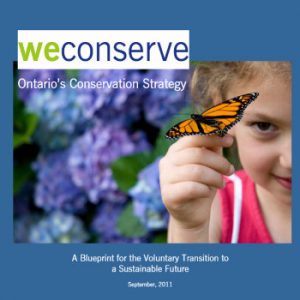
Here's the one I wrote for the Conservation Council of Ontario (CCO) in 2011, drawing on the work and goals of many of Ontario' top environmental and conservation organizations.
"We Conserve: a Blueprint for the Voluntary Transition to a Sustainable Future" sets out the CCO's mission as a catalyst for the voluntary transition to a conserver society in Ontario. It identifies challenge targets for each of ten priority actions:
-
- Help Nature
- Save Water
- Save Energy
- Use Green Power
- Drive Less
- Eat Smart
- Waste Less
- Prevent Pollution
- Buy Green
- Live Local
The strategy laid out a roadmap for Ontario based on collaboration and voluntary leadership. It still stands as an example of what could actually be accomplished if we all worked together.
Missing Values (1999-2001)
Values matter. They are the foundation for good government, and a means to compare government plans and actions against what society deems important.
 In 1993, Ontario enacted the Ontario Environmental Bill of Rights, which acknowledged the inherent value of the natural environment and the public's right to "a healthful environment." The Bill described key measures to ensure the environment was given full consideration in government planning, including:
-
-
- a requirement for Ministry Statements of Environmental Values
- an Environmental Commissioner to report annually on government progress
- the ability for the public to request reviews of existing legislation etc., or to request an investigation into possible contraventions of the Act.
-
In 1999, I decided to put the Statements of Environmental Values to the test. From 1999 to 20001, I compiled an annual report that compared Ontario ministry Business Plans to their Statement of Environmental Values to see if the values were actually being applied in practice.
The results were consistently disappointing, demonstrating a lack of real world commitment to integating environmental values into strategic planning, public consultation, and policy development.
The 2001 report can be found here.